
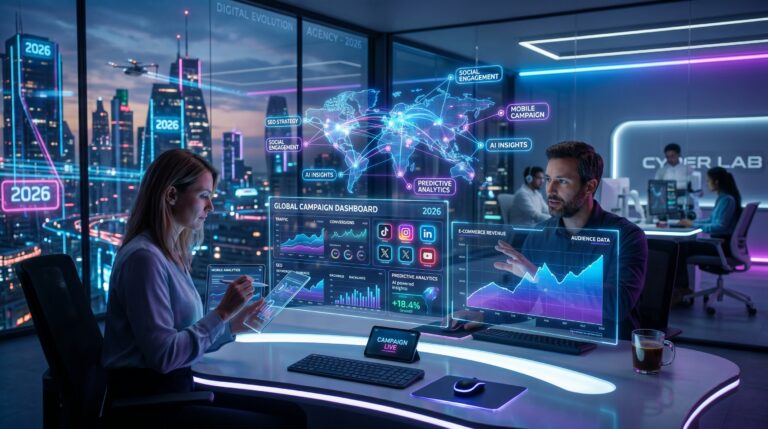
 AI-powered digital marketing ecosystem with analytics dashboards and global online connectivity in 2026
Digital marketing refers to the strategic use of online channels, platforms, and technologies to promote products, services, and brands. In 2026, it has become the backbone of global business growth, driven by AI automation, personalized user experiences, and data-centric decision-making. Businesses no longer rely solely on traditional advertising; instead, they integrate digital ecosystems to reach highly targeted audiences.
Digital marketing matters more than ever because consumer behavior has fully shifted online. People now discover brands through search engines, social media, video platforms, and AI recommendations. This transformation has created a highly competitive environment where visibility determines success.
Key aspects of digital marketing in 2026 include:
Additionally, businesses now depend heavily on omnichannel strategies that connect every digital touchpoint. Whether a user interacts via mobile, desktop, or voice assistant, consistency in messaging is critical. Digital marketing is no longer optional—it is essential for survival, scalability, and long-term growth in every industry.
 Timeline showing evolution of digital marketing from 2000s to AI-driven marketing in 2026
Digital marketing has evolved significantly over the last decade, transitioning from simple online ads to advanced AI-powered ecosystems. In 2026, it is defined by automation, personalization, and predictive analytics. Businesses now rely on real-time data to make decisions that optimize customer journeys.
The evolution can be broken down into key phases:
Modern digital marketing focuses on user intent rather than mass targeting. Algorithms now understand behavior patterns, allowing brands to deliver personalized content at scale. Video-first marketing, influencer ecosystems, and voice search optimization have also become standard practices.
Important changes shaping the industry:
These developments have made digital marketing more efficient but also more competitive. Brands that fail to adapt risk losing visibility and engagement in rapidly changing digital environments.
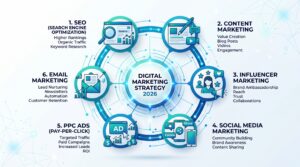 Circular diagram showing SEO, PPC, social media, content marketing and email marketing in digital strategy
Digital marketing consists of several interconnected components that work together to build brand awareness and drive conversions. Each component plays a unique role in creating a strong online presence.
The major components include:
These elements work best when integrated into a unified strategy. For example, SEO drives organic traffic while PPC provides immediate visibility. Social media builds engagement, while email marketing nurtures long-term customer relationships.
Key benefits of combining these components:
In 2026, integration is more important than isolation. Businesses that treat each channel separately often struggle with inconsistent messaging. A successful digital marketing strategy ensures all components work together seamlessly to guide users from awareness to conversion.
Search Engine Optimization (SEO) remains one of the most powerful digital marketing strategies in 2026. It focuses on improving website visibility on search engines through organic ranking methods. With increasing competition online, SEO is essential for long-term traffic generation.
Modern SEO is no longer about keyword stuffing; it is about understanding user intent, content quality, and technical performance.
Key SEO elements include:
Benefits of SEO in 2026:
Search engines now use AI-based algorithms to evaluate content relevance. This means businesses must focus on high-quality, helpful, and structured content. SEO is not just a marketing tactic—it is a long-term investment in digital visibility and brand authority.
Content marketing is the foundation of digital marketing success in 2026. It involves creating valuable, relevant, and consistent content to attract and retain a clearly defined audience. Instead of directly promoting products, content marketing builds trust and authority.
Types of content used in modern marketing:
Strong content marketing strategies focus on solving user problems rather than selling directly. This approach increases engagement and improves brand loyalty.
Key advantages:
In 2026, AI tools assist in content creation, but human creativity remains essential for authenticity. The most successful brands combine data insights with storytelling to create impactful content that resonates with their audience.
Social media marketing plays a crucial role in digital marketing strategies in 2026. Platforms like Instagram, TikTok, LinkedIn, and YouTube have become powerful ecosystems for brand communication and customer engagement.
Social media is no longer just about posting content—it is about building communities and conversations.
Key strategies include:
Benefits of social media marketing:
Algorithms now prioritize meaningful interactions over passive content consumption. This means brands must focus on authenticity, storytelling, and audience engagement. Social media marketing has become a critical pillar for digital brand success.
Paid advertising, also known as performance marketing, is essential for fast and measurable results in digital marketing. In 2026, platforms like Google Ads, Meta Ads, and programmatic networks offer highly advanced targeting options.
Key paid advertising formats:
Advantages of paid advertising:
Modern advertising relies heavily on AI optimization, which automatically adjusts bids, targeting, and creatives for better results. Businesses can now reach users based on behavior, interests, and intent signals rather than broad demographics.
Paid marketing works best when combined with SEO and content marketing for a balanced digital strategy.
Email marketing remains one of the highest ROI channels in digital marketing even in 2026. It focuses on nurturing leads and maintaining long-term customer relationships through personalized communication.
Types of email campaigns:
Benefits of email marketing:
Modern email marketing uses AI to personalize subject lines, content, and timing. This increases open rates and engagement. Unlike social media, email marketing provides direct access to the customer without algorithm interference.
 AI brain managing digital marketing automation, analytics, and customer targeting systems
Artificial intelligence is revolutionizing digital marketing in 2026. It enables automation, predictive analytics, and hyper-personalization across all channels.
Key AI applications:
Benefits of AI in marketing:
AI allows marketers to analyze large datasets and identify patterns that humans cannot easily detect. This leads to smarter strategies and higher conversion rates.
Data analytics is the backbone of digital marketing success in 2026. It helps businesses understand user behavior, measure performance, and optimize strategies.
Key metrics include:
Benefits of analytics:
Advanced tools now use AI to predict future trends and user behavior, making marketing more proactive than reactive.
Digital marketing offers vast career opportunities in 2026 due to increasing global demand. Businesses require skilled professionals to manage SEO, social media, content, and analytics.
Popular career roles:
Skills required:
The industry continues to grow, offering both freelance and full-time opportunities across global markets.
The future of digital marketing is driven by AI, automation, personalization, and immersive technologies like AR and VR. In 2026 and beyond, marketing will become even more user-centric and predictive.
Future trends include:
In conclusion, digital marketing is no longer just a promotional tool—it is the foundation of modern business success. Companies that adapt to evolving technologies and focus on customer experience will dominate the digital landscape in 2026 and beyond.