
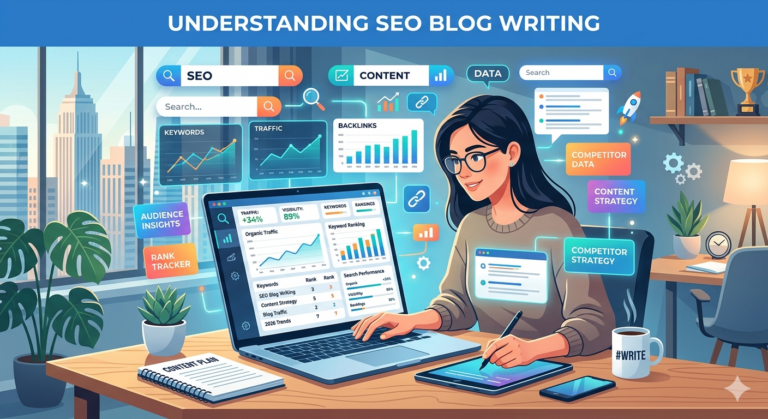

A visual representation of how SEO blog writing combines content creation with search engine optimization strategies.
SEO blog writing is the process of creating content that ranks in search engines while delivering value to readers. In 2026, SEO is no longer about keyword stuffing—it focuses on user intent, topical authority, and content depth. A well-structured SEO blog targets multiple search queries, not just one primary keyword. This means one article can rank for hundreds or even thousands of related keywords if it is built strategically.
The goal of SEO blog writing is to attract organic traffic, improve visibility, and convert readers into leads or customers. To achieve this, content must balance readability with optimization. Search engines now analyze context, semantic relevance, engagement signals, and content freshness.
Key focus areas in SEO blog writing:
Modern SEO blogs are not just articles—they are structured knowledge assets designed to dominate search results. The better your structure and intent matching, the higher your chances of ranking across multiple keyword variations.
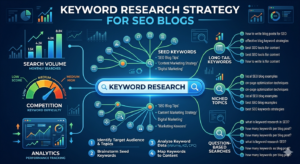
Keyword research forms the foundation of every successful SEO blog post.
Keyword research is the foundation of every high-ranking SEO blog post. Without it, content lacks direction and search visibility. The aim is not just to find one keyword but to identify clusters of related keywords that represent user intent at different stages.
A strong keyword strategy includes informational, navigational, and transactional queries. Informational keywords bring traffic, while transactional keywords drive conversions. Combining both creates a balanced SEO ecosystem.
Important keyword research steps:
A powerful SEO blog targets multiple keyword layers:
Instead of writing separate articles for every keyword, modern SEO focuses on “keyword mapping.” This allows one article to rank for hundreds of related searches, increasing visibility exponentially.
The objective is to build content that answers multiple search queries in a single authoritative post. This is how blogs begin ranking across a wide keyword spectrum, sometimes exceeding 1000 keyword variations naturally.
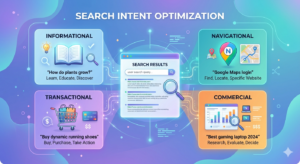
Understanding search intent is essential for ranking SEO blog content effectively.
Search intent is the reason behind every Google search. Understanding it is essential for writing SEO blog posts that actually rank. If your content does not match intent, it will not rank—even if it is well written.
There are four main types of search intent:
SEO blogs mostly focus on informational intent, but high-ranking content often includes multiple intent layers within a single post.
To optimize for intent:
Intent-based optimization improves dwell time and reduces bounce rate, both of which are ranking signals. Google prioritizes content that satisfies user queries fully without requiring additional searches.
Point-based execution:
When intent is properly aligned, one blog post can rank for thousands of keyword variations because Google understands it as a comprehensive solution rather than a single-topic article.
A strong structure is essential for ranking SEO blog posts. Search engines scan content hierarchy to understand relevance and topic depth. A well-structured blog improves indexing, readability, and keyword distribution.
The ideal SEO blog structure includes:
A structured blog also enhances user experience, which directly impacts rankings. Readers should be able to scan content and find answers quickly.
Best structure practices:
Why structure matters for SEO:
A poorly structured blog confuses both users and search engines. On the other hand, a clean structure ensures your content can rank for multiple keywords by clearly signaling relevance for each subtopic. This is a key factor in scaling SEO visibility across thousands of search queries.
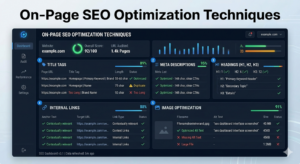
On-page SEO ensures that content is optimized for both search engines and users.
On-page SEO refers to optimizing elements within your blog to improve rankings. It plays a critical role in helping search engines understand your content relevance and keyword targeting.
Key on-page SEO elements:
Effective on-page optimization ensures your blog is both search-engine-friendly and user-friendly. It also improves click-through rates and indexing speed.
Important optimization checklist:
Additional ranking boosters:
On-page SEO is not about over-optimization—it is about clarity and relevance. When done correctly, it helps a single blog post rank for hundreds of keyword variations by strengthening topical signals across the entire page.

A structured content strategy is essential for creating SEO blogs that rank and engage users.
Content writing for SEO is about combining value, structure, and keyword intelligence. High-ranking blogs are not written randomly—they follow a strategic framework that aligns with both users and search engines.
A strong content strategy focuses on:
To write SEO-friendly content:
Point-based writing techniques:
Modern SEO content is designed to rank for clusters of keywords rather than single terms. This is achieved by covering every possible variation of a topic within a single comprehensive post.
When executed correctly, a well-written SEO blog can rank across hundreds or even thousands of keyword combinations, making it a powerful organic traffic asset.
To achieve ranking across 1000+ keywords, advanced keyword expansion is essential. This goes beyond traditional keyword research and focuses on semantic coverage, topic depth, and entity-based SEO. Modern search engines understand context, so a single well-built article can rank for thousands of related queries without separate pages.
The expansion strategy includes building keyword ecosystems rather than isolated terms. This means covering every possible variation a user might search around a topic.
Key expansion methods:
Point-based execution:
For example, “how to write SEO blog posts” can expand into:
By strategically expanding content coverage, one blog post becomes a “topic hub” capable of ranking across a wide keyword network, significantly increasing organic visibility.
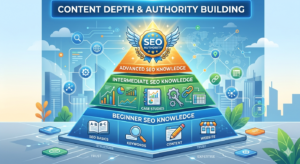
Depth and expertise determine how strongly a blog ranks in search engines.
Content depth is one of the strongest ranking signals in modern SEO. Search engines prioritize pages that demonstrate authority, expertise, and completeness. Shallow content rarely ranks for competitive keywords, especially in 2026 where AI-driven ranking systems evaluate topical authority.
To build authority, your blog must fully cover the topic from multiple angles, leaving no informational gaps.
Key depth-building strategies:
Point-based approach:
Authority is also built through consistency and completeness. A blog that answers every possible user query signals strong expertise to search engines.
When content depth is combined with structured optimization, it increases the likelihood of ranking for multiple keyword variations simultaneously. This is how single SEO blogs dominate entire keyword clusters rather than just one search term.
Internal linking is a powerful SEO technique that helps search engines understand site structure and content relationships. It also improves user navigation and distributes authority across pages. Topic clustering takes this concept further by grouping related content into interconnected hubs.
In SEO blog writing, internal linking strengthens relevance signals and helps rank for multiple keywords across a website.
Key internal linking strategies:
Point-based execution:
Topic clustering example:
This structure helps Google understand your site as an authority on a topic. It also increases crawl efficiency, improves indexing, and distributes ranking power across multiple pages. Proper internal linking can significantly expand keyword reach and improve overall SEO performance.
User experience (UX) is now a critical ranking factor in SEO. Search engines analyze how users interact with content to determine its quality. Metrics like time on page, bounce rate, and scroll depth directly influence rankings.
A well-optimized SEO blog must prioritize readability and engagement.
Key UX optimization factors:
Point-based engagement strategies:
Engagement signals also include how well content satisfies user intent. If users find answers quickly and stay longer on the page, it signals high-quality content to search engines.
Improving UX leads to:
SEO success is no longer just about keywords—it is about delivering a smooth and valuable reading experience. The better your UX, the more likely your content will rank across multiple keyword variations.
Search engine algorithms in 2026 focus heavily on AI-driven understanding of content quality, relevance, and authority. This means SEO optimization is now more about context and structure than keyword density.
Modern SEO optimization includes:
Point-based optimization techniques:
Search engines now evaluate:
To stay competitive, SEO blogs must evolve into knowledge hubs rather than simple articles. Each blog should act as a complete resource covering all aspects of the topic.
This approach allows a single post to rank for thousands of keyword variations, as search engines interpret it as a comprehensive authority page rather than a narrow keyword-targeted article.
Writing SEO blog posts that rank for 1000+ keywords requires a combination of strategy, structure, and depth. It is no longer enough to target a single keyword—you must build complete topical ecosystems.
The key success factors include:
Point-based summary:
SEO success in 2026 depends on how well your content satisfies both users and AI-driven search systems. A well-structured blog can become a long-term traffic asset, consistently ranking across thousands of search queries.
By applying these strategies, your SEO blog posts can evolve from simple articles into powerful ranking engines capable of dominating entire keyword categories.
If you want to go beyond theory and build real, job-ready SEO skills, you can learn SEO blog writing through Asmat Institute. While this guide helps you understand the fundamentals of SEO content creation, practical results come from structured training, live practice, and expert-led guidance.
At Asmat Institute, learners are trained on how SEO actually works in real business environments. The focus is not just on writing blogs, but on building content that ranks, attracts traffic, and converts readers into customers. You get hands-on experience with keyword research, on-page optimization, content strategy, and modern AI-based SEO techniques used in 2026.
Key learning benefits:
If you are serious about building a career in SEO or digital marketing, Asmat Institute provides a structured learning path to help you grow from beginner to professional level.