
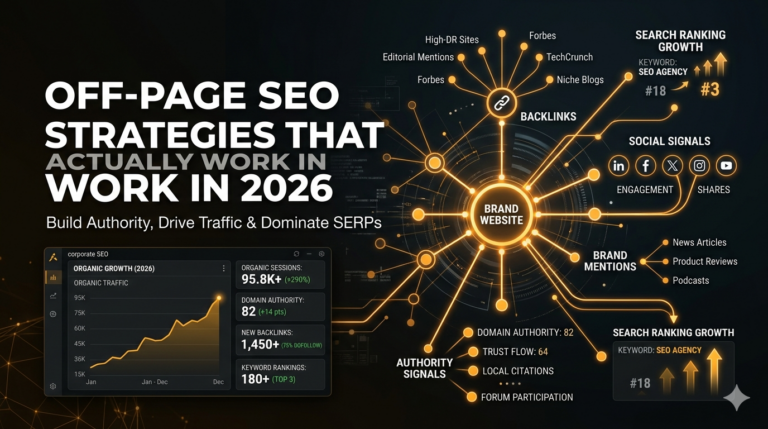
Modern off-page SEO strategies help businesses build authority, trust, and higher search rankings in 2026.
Search engine optimization is no longer limited to website content and technical improvements. In 2026, search engines evaluate websites based not only on what exists inside the site but also on how the rest of the internet reacts to that brand. This is where off-page SEO strategies become essential.
Off-page SEO refers to all optimization activities performed outside a website to improve search engine rankings, brand authority, trust, and online visibility. These strategies help search engines understand whether a website is credible, authoritative, and valuable enough to rank above competitors.
Today, search engines use advanced ranking systems powered by AI, user behavior analysis, topical authority signals, entity recognition, and trust evaluation. Because of this, traditional link-building alone is no longer enough. Businesses now need a complete off-page SEO strategy that combines backlinks, digital PR, social visibility, brand mentions, content distribution, and authority building.
For businesses, agencies, creators, and marketers, mastering off-page SEO has become one of the biggest factors in long-term organic growth. Whether you run an e-commerce website, local business, educational institute, SaaS company, or personal brand, strong off-page SEO directly impacts search visibility and organic traffic.
At ASMAT, students learn how modern off-page SEO works beyond outdated backlink tactics. The focus is on building sustainable search authority using real-world SEO strategies aligned with modern search engine algorithms.
Off-page SEO refers to all activities performed outside your website that help improve search engine rankings and digital authority. Unlike on-page SEO, which focuses on optimizing website content, meta tags, internal links, and technical structure, off-page SEO focuses on how external platforms and users interact with your brand online.
Search engines treat off-page signals as trust indicators. When authoritative websites mention or link to your content, search engines interpret this as proof that your website provides valuable information.
However, modern off-page SEO extends far beyond backlinks. Search engines now analyze:
This means a successful off-page SEO strategy must build both visibility and credibility simultaneously.
In 2026, off-page SEO is primarily about authority building rather than simply increasing backlink quantity.
Search engine algorithms have become significantly smarter over the years. Earlier SEO strategies focused heavily on keyword density and backlink volume, but modern search engines prioritize trust, expertise, relevance, and authority.
This evolution has made off-page SEO more important than ever.
Today, two websites with similar content quality may rank differently because one has stronger off-page authority signals. Search engines prefer brands that are actively discussed, referenced, and trusted across multiple online platforms.
Search engines use external references to determine whether a website is trustworthy.
Strong off-page SEO helps establish websites as industry leaders.
Popular and widely mentioned brands receive stronger visibility advantages.
When other websites link to your content, it signals usefulness and relevance.
Strong off-page authority often separates top-ranking websites from average competitors.
In competitive industries, off-page SEO often becomes the deciding factor between ranking on page one or getting buried in search results.
Backlinks remain one of the strongest off-page SEO ranking signals in 2026. A backlink is simply a link from another website pointing to your site.
However, modern link building focuses on quality rather than quantity.
Search engines now evaluate:
A few high-authority backlinks from trusted websites are now far more valuable than hundreds of low-quality links.
Writing valuable articles for relevant websites remains one of the safest and most effective methods.
Creating useful resources, guides, tools, or research content naturally attracts backlinks.
Finding broken links on websites and suggesting your content as a replacement.
Earning mentions through news publications, interviews, and expert commentary.
Statistics, reports, and case studies often generate organic backlinks naturally.
At ASMAT, students learn white-hat link-building strategies that align with modern SEO guidelines instead of outdated spam techniques.
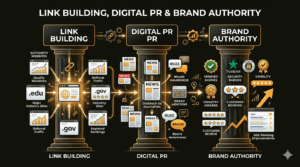
Quality backlinks and digital PR remain key pillars of successful off-page SEO.
Digital PR has become one of the most powerful off-page SEO strategies in modern search optimization.
Instead of only focusing on backlinks, digital PR aims to increase online visibility, authority, and brand recognition across trusted platforms.
When reputable websites mention your brand, products, or expertise, search engines interpret those mentions as authority signals.
Even unlinked brand mentions can contribute positively to SEO because modern search systems understand entity relationships and contextual relevance.
Brands using strong digital PR strategies often dominate competitive search results because they build trust beyond their own websites.
Social media may not directly impact rankings in the same way backlinks do, but it strongly supports off-page SEO performance.
Platforms like Instagram, LinkedIn, Facebook, and YouTube help amplify content visibility, attract engagement, and increase brand discovery.
Strong social media presence contributes indirectly to SEO through:
When content performs well socially, it often attracts bloggers, journalists, and websites that may later reference or link to it.
In 2026, successful SEO strategies combine search optimization with strong social media visibility.
Guest posting remains effective in 2026, but search engines now prioritize relevance and authenticity over mass publishing.
Low-quality guest posting solely for backlinks no longer works effectively.
Modern guest posting focuses on:
The goal is no longer just obtaining a backlink. It is about building authority in your industry.
Quality guest posting improves both SEO authority and brand visibility simultaneously.
Local SEO has become one of the strongest off-page SEO components for businesses targeting specific geographic areas. In 2026, search engines heavily prioritize local trust signals when ranking businesses for location-based searches.
For example, when users search for:
Search engines evaluate multiple off-page local authority factors before deciding rankings.
A fully optimized business profile improves visibility in local search results and map listings.
Positive reviews improve trust, click-through rates, and local ranking performance.
Business listings across directories help search engines verify business legitimacy.
Mentions on local blogs, publications, and directories strengthen authority.
Links from local websites improve geographic relevance.
For institutes and businesses like ASMAT, local SEO plays a major role in attracting students searching for professional digital marketing training programs.
Content marketing is deeply connected with off-page SEO because strong content naturally attracts engagement, mentions, shares, and backlinks.
In modern SEO, content is no longer created only for website visitors. It is also designed to:
High-quality content acts as the foundation for successful off-page SEO campaigns.
When content provides unique value, off-page SEO becomes easier because users and websites reference it naturally.
Influencer collaborations are now an important part of off-page SEO strategy in 2026.
Search engines increasingly recognize brand visibility across trusted creators, niche experts, and industry communities.
When influencers mention brands, products, or services, it creates:
Modern SEO is becoming increasingly connected with digital branding and creator ecosystems.
Community participation remains one of the most underrated off-page SEO strategies.
Search engines evaluate brand visibility across discussions, forums, Q&A platforms, and online communities to understand topical authority.
However, spam promotion no longer works.
The goal is to provide real value through expertise and helpful participation.
Businesses and professionals who actively contribute useful information often build stronger digital authority over time.
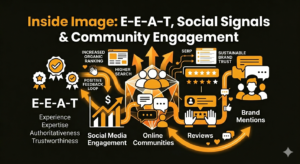
E-E-A-T signals and community engagement are essential components of modern off-page SEO.
In 2026, Google’s focus on E-E-A-T has become central to off-page SEO.
E-E-A-T stands for:
Search engines now analyze whether brands and content creators demonstrate real expertise within their niche.
Being referenced by authoritative websites improves credibility.
Strong professional visibility strengthens trust signals.
Positive discussions across platforms improve authority.
Trusted backlinks support expertise recognition.
Publishing insights, research, and educational content improves topical authority.
For educational institutes like ASMAT, building E-E-A-T is critical for improving search rankings and user trust simultaneously.
Many websites still follow outdated off-page SEO tactics that can negatively impact rankings.
Modern search engines are highly effective at identifying manipulative link-building patterns and low-quality authority signals.
Low-quality paid links often harm SEO performance.
Overusing exact-match keywords appears unnatural.
Negative brand perception affects trust signals.
Publishing thin content solely for backlinks is ineffective.
AI-generated spam links are easily detected.
Artificial social engagement rarely creates sustainable SEO growth.
Successful off-page SEO in 2026 focuses on authenticity, relevance, and authority.
At ASMAT, students learn practical off-page SEO strategies aligned with real-world search engine algorithms and business growth goals.
Instead of outdated backlink tactics, training focuses on:
Students learn how modern authority-building works across search engines and digital platforms.
Safe and sustainable backlink acquisition methods are taught using practical strategies.
Students understand how to generate online visibility and authority naturally.
Training includes integrating SEO with content marketing and social media growth.
Students gain hands-on experience with SEO campaigns, outreach strategies, and optimization planning.
The goal is not only to improve rankings but to build long-term digital authority.
Off-page SEO in 2026 is no longer just about backlinks. It is about building trust, authority, visibility, and brand relevance across the internet.
Modern off-page SEO strategies combine:
Businesses and marketers who focus on authentic authority-building consistently outperform those relying on outdated SEO shortcuts.
As search engines become smarter, off-page SEO will continue evolving toward credibility, expertise, and audience trust.
For students, marketers, and professionals looking to master modern SEO, understanding off-page optimization has become essential for long-term digital success.