
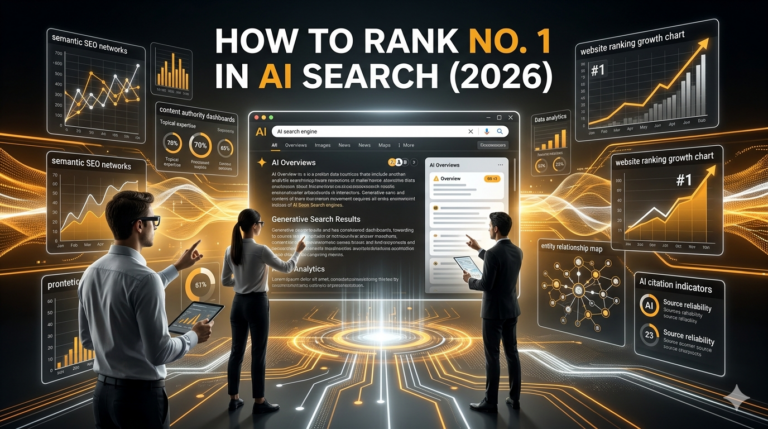
Modern AI search optimization strategies helping websites achieve top visibility in AI-powered search results.
The search landscape has changed dramatically in 2026. Traditional SEO remains important, but ranking in AI-powered search engines now requires a different strategy. Users increasingly rely on AI assistants, conversational search engines, AI overviews, and generative search experiences to find information. Instead of displaying only a list of websites, AI systems generate direct answers by selecting information from trusted and authoritative sources.
Businesses, marketers, bloggers, publishers, and brands that want sustainable organic visibility must optimize not only for search engines but also for AI systems. This practice is commonly known as AI Search Optimization (AISO), Generative Engine Optimization (GEO), or AI Visibility Optimization.
To rank at the top of AI search results, websites need strong topical authority, entity recognition, trust signals, structured content, semantic relevance, and comprehensive coverage of user intent. AI models prioritize content that answers questions completely, demonstrates expertise, and provides reliable information.
This guide explains the most effective strategies for ranking No. 1 in AI search during 2026 while building long-term authority across search ecosystems.
AI search differs significantly from traditional search engines. Instead of matching keywords to webpages, AI systems analyze context, entities, user intent, and semantic relationships before generating answers.
When users ask AI tools a question, the system gathers information from trusted sources and creates a summarized response. This means visibility depends on whether your content is considered authoritative enough to become part of the AI-generated answer.
Several factors influence AI search rankings:
Organizations that understand these ranking factors gain a significant competitive advantage in AI-driven search environments.
One of the biggest shifts in AI search is the move away from isolated keyword targeting. AI systems evaluate expertise across entire topics rather than individual pages.
A website publishing hundreds of interconnected articles on a specific subject is more likely to be cited by AI systems than a site with only a few general articles. This is because AI models recognize topical authority and domain expertise.
For example, if your niche is digital marketing, you should create comprehensive content clusters around:
Instead of creating ten disconnected articles, create fifty or more interconnected resources that comprehensively cover every aspect of your niche.
This approach helps AI systems identify your website as a trusted authority, increasing the likelihood of inclusion in AI-generated responses.
AI systems prioritize content that answers questions quickly, clearly, and comprehensively. Every article should be designed around solving a specific user problem.
User intent generally falls into four categories:
Users want knowledge, explanations, guides, tutorials, and educational resources.
Examples include:
Users are searching for a specific brand, website, company, or resource.
Users are comparing options before making decisions.
Users are ready to purchase, subscribe, register, or take action.
To rank in AI search, content should address primary intent while also covering secondary and related intents. This creates comprehensive answers that AI systems can confidently reference.
A well-optimized article anticipates follow-up questions and answers them within the same content, reducing the need for users to seek information elsewhere.
Entities have become one of the most important ranking factors in AI search. An entity is a recognized concept such as a person, company, product, place, technology, or topic.
AI models understand relationships between entities rather than relying solely on keywords.
For example, an article about AI search should naturally connect related entities such as:
When creating content:
Entity optimization strengthens semantic relevance and improves the probability of being selected as an authoritative AI source.
AI systems prefer content that is easy to scan, understand, and extract information from. Proper formatting significantly increases AI visibility.
Recommended structure includes:
Use descriptive h3 and h4 headings that clearly communicate section topics and answer specific user questions.
Maintain readability by limiting paragraph length while ensuring ideas remain fully developed and informative.
Include frequently asked questions that mirror real-world user queries.
Organize important information into structured formats that AI systems can easily interpret and summarize.
Provide concise explanations before expanding into detailed discussions.
The easier your content is to process, the more likely AI systems are to extract and reference information from it.
Traditional search often relied on short keyword phrases. AI search is driven by natural language and conversational queries.
Users now search using complete questions such as:
Content should reflect this shift by incorporating natural language patterns and comprehensive answers.
Effective optimization strategies include:
This approach improves the likelihood of appearing in AI-generated responses and conversational search results.
AI systems increasingly prioritize original information over recycled content. Websites that contribute unique value have a stronger chance of becoming authoritative sources.
Examples include:
Original content creates information gain, a factor that helps differentiate your website from thousands of similar resources.
AI systems are more likely to reference sources that provide new knowledge rather than repeating existing information.
In 2026, Experience, Expertise, Authoritativeness, and Trustworthiness (EEAT) have become essential signals for AI search systems. While traditional search engines have emphasized these factors for years, AI-powered search platforms rely on them even more heavily when selecting sources for generated answers.
AI models attempt to identify content created by knowledgeable individuals or organizations with demonstrated expertise. Content that lacks credibility, author information, supporting evidence, or real-world experience is less likely to be referenced in AI-generated responses.
To strengthen EEAT:
A website that consistently demonstrates expertise across multiple content pieces becomes a more trusted source for AI systems. Over time, this trust can increase citation frequency, improve visibility, and strengthen overall AI search performance.
One of the most important goals in AI search optimization is becoming a source that AI systems reference when generating answers. This process is often called AI Citation Optimization.
Unlike traditional rankings, where users click through search results, AI systems may summarize information directly within generated responses. Therefore, websites must structure information in ways that are easy for AI models to understand and cite.
Effective citation optimization strategies include:
When AI systems can quickly identify valuable information, the likelihood of being selected as a citation source increases significantly.
Content designed for citation often gains visibility across multiple AI platforms, creating long-term traffic and brand awareness benefits.
Semantic SEO focuses on helping search engines and AI systems understand meaning rather than matching exact keywords. This approach aligns perfectly with how AI search operates.
Instead of targeting a single keyword repeatedly, successful content covers related topics, entities, questions, and concepts connected to the main subject.
For example, an article about AI Search Optimization should naturally discuss:
Semantic SEO enables AI systems to understand the full context of a topic rather than relying on isolated keywords.
This broader understanding increases relevance for hundreds or even thousands of related search queries, making large-scale keyword visibility more achievable.
Structured data helps AI systems interpret webpage content more accurately. Schema markup provides machine-readable information that clarifies page purpose, content type, and relationships between entities.
In 2026, structured data continues to play an important role in AI search visibility because it reduces ambiguity and improves content understanding.
Important schema types include:
Additional schema opportunities include:
Proper implementation improves content discoverability and strengthens the signals AI systems use when selecting authoritative sources.
Internal linking remains one of the most effective methods for developing topical authority. AI systems analyze how content is connected across a website to understand subject expertise and content relationships.
A strong internal linking framework should guide users and search systems through related information in a logical sequence.
Best practices include:
Benefits of strong internal linking include:
Websites with organized topic structures are more likely to be viewed as authoritative sources by AI search systems.
Brand authority is becoming increasingly important in AI search. AI systems often favor sources that have established recognition across multiple platforms.
A strong brand creates trust signals that influence whether content is selected as a reference source.
Brand-building strategies include:
As brand awareness grows, AI systems become more likely to recognize the organization as a reliable source of information.
This recognition can contribute significantly to AI citation opportunities and overall search visibility.
AI Overviews have transformed how users interact with search results. These generated summaries often appear before traditional organic listings, making them a critical visibility opportunity.
To improve inclusion in AI-generated answers:
Content that follows this structure becomes easier for AI systems to summarize and reference.
The goal is to make information extraction as straightforward as possible while maintaining depth and accuracy.
Creating excellent content is only part of the equation. Distribution helps establish authority signals that influence AI search visibility.
AI systems evaluate content prominence across the web. A topic discussed and referenced widely is more likely to be recognized as important.
Effective distribution channels include:
Consistent distribution increases visibility, encourages citations, and strengthens overall brand authority.
These signals contribute indirectly to AI search rankings by improving recognition and trust.
Many websites struggle with AI visibility because they continue using outdated SEO tactics that no longer align with modern search systems.
Common mistakes include:
Additional issues include:
Avoiding these mistakes improves both traditional search performance and AI search visibility.
Before publishing content, verify that the following elements are present:
The more items completed, the stronger the likelihood of AI search success.
AI search will continue evolving throughout the coming years. Future ranking systems are expected to place even greater emphasis on expertise, entity relationships, real-world experience, and information quality.
Websites that invest in long-term authority building rather than short-term ranking tactics will gain the greatest competitive advantage.
Future trends may include:
Businesses that adapt early will be positioned to capture significant organic visibility opportunities as AI search adoption continues growing.
Ranking No. 1 in AI Search in 2026 requires a shift from traditional keyword-focused SEO to authority-driven optimization. Success depends on topical expertise, semantic relevance, entity optimization, structured content, brand recognition, and user-focused information.
The most effective strategy is to create comprehensive content ecosystems that answer user questions better than competing sources. AI systems reward websites that consistently provide trustworthy, detailed, and well-structured information.
Organizations that focus on EEAT, AI citations, semantic SEO, internal linking, structured data, and brand authority will be best positioned to dominate AI-powered search results.
The websites that become trusted knowledge sources today are the ones most likely to become the primary references used by AI search systems tomorrow. By implementing these strategies consistently, businesses can build sustainable visibility, attract qualified traffic, and achieve long-term success in the rapidly evolving AI search landscape.