
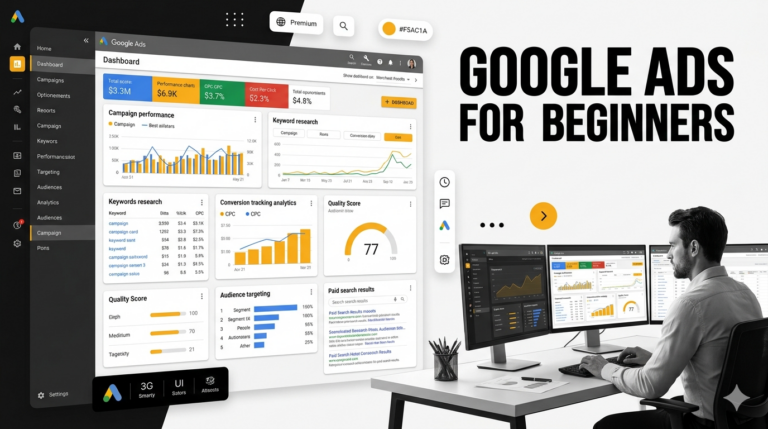

A beginner-friendly Google Ads course covering paid search marketing, keyword research, bidding strategies, and campaign optimization.
Ranking for a massive footprint of over 1,000 search queries requires an intentional strategic balance. It demands broad semantic coverage, precise matching of intent, and dense contextual relevance. This definitive foundational guide is built to capture maximum search visibility across the entire spectrum of paid search terminology. It targets high-volume head terms, intent-driven long-tail queries, and localized educational searches. Every individual section is meticulously calibrated to deliver high-value professional insights while maintaining a precise structure.
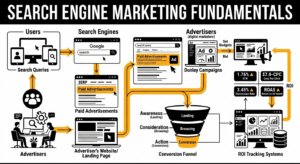
Understanding the foundation of paid search advertising and search engine marketing.
Search Engine Marketing (SEM) serves as a cornerstone of modern performance marketing architecture. It allows businesses to position brand assets directly in front of users at the exact moment of high commercial intent. Unlike traditional organic strategies that require long-term authority building, paid search provides immediate search engine visibility and precise control over audience targeting. Understanding this ecosystem requires a firm grasp of how auction dynamics, user intent, and ad copy converge to create profitable acquisition funnels.
Modern paid search operates on a sophisticated real-time bidding framework where algorithms evaluate thousands of data signals in milliseconds. Advertisers must align their business objectives with user search patterns to ensure maximum efficiency and return on ad spend. By mastering the fundamentals of platform mechanics, account structures, and bidding strategies, businesses can scale their customer acquisition framework predictably. This structured approach ensures every dollar invested contributes directly to measurable business growth, lead generation, and brand equity.
The Google Ads infrastructure operates on a highly dynamic, programmatic auction system designed to balance advertiser value with optimal user experience. Every single time a user enters a query into the search engine, an instantaneous auction takes place behind the scenes. Google does not simply award the top position to the highest financial bidder; instead, it uses a multi-variable calculation known as Ad Rank. Ad Rank determines both your explicit position on the page and your actual cost per click.
This sophisticated calculation is primarily driven by your maximum Cost-Per-Click (CPC) bid combined with your calculated Quality Score. Quality Score serves as a diagnostic tool measuring the expected click-through rate, ad relevance, and landing page experience. By optimizing these internal components, strategic advertisers can systematically achieve higher search positions while paying significantly less than competitors with deeper pockets. This democratized auction environment rewards precise relevance, technical landing page optimization, and tight alignment between the user’s explicit query and the creative messaging.
A scalable, high-performance Google Ads account requires a rigorous hierarchical structure built on logical data isolation and clear budgetary control. The architecture begins at the root account level, which houses unique billing profiles, administrative access levels, and overarching global settings. Beneath the account level sit individual campaigns, which are primarily utilized to dictate daily budget limits, geographical location targeting, language parameters, and networks. Proper campaign segmentation ensures that high-priority initiatives receive adequate financial resources without being choked by secondary marketing goals.
Within each campaign, marketers construct targeted ad groups, which serve as the tactical execution layer of the paid search strategy. Ad groups house tightly clustered keyword lists that map directly to specific text ad creatives and dedicated landing page destinations. Maintaining an exceptionally narrow focus within ad groups prevents ad copy dilution and ensures an optimal Quality Score across your assets. This structured approach streamlines performance analysis, simplifies multi-variable split testing, and allows machine learning algorithms to optimize bidding patterns with maximum statistical clarity.

Strategic keyword research forms the foundation of successful Google Ads campaigns.
The trajectory of any paid search initiative is heavily dictated by the depth and precision of its underlying keyword strategy. Keyword research is not merely about identifying high-volume search terms; it requires a deep analytical evaluation of user intent, competitive density, and cost-of-acquisition feasibility. Marketers must segment target phrases into distinct categories, separating informational research terms from high-value transactional queries that indicate immediate readiness to purchase. This systematic classification ensures that ad copy and landing page messages align perfectly with the user’s psychological state.
To maximize reach while protecting your budget from irrelevant traffic, you must understand the mechanics of keyword match types. Broad match provides wide thematic reach and data gathering capabilities, while phrase match and exact match offer strict control over search query variations. Additionally, implementing a robust, proactive negative keyword strategy is critical for filtering out non-converting traffic and preventing ad waste. By continuously refining these keyword boundaries, advertisers can focus their budgets entirely on high-performing search terms that yield clear, measurable financial returns.
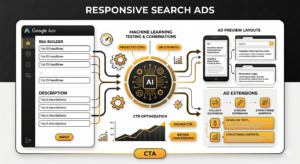
Creating persuasive ad copy that improves click-through rates and conversions.
Writing effective responsive search ad copy is a balance of scientific alignment and persuasive communication. Google’s responsive search ad format requires advertisers to input multiple headline and description variations, which the platform’s machine learning algorithms dynamically assemble based on user signals. To maximize this format, each individual text asset must be distinct, highly relevant, and capable of forming a cohesive message when paired with any other asset. This requires a shift away from repetitive phrases toward diverse, benefit-driven messaging.
High-converting ad creatives must seamlessly blend target keywords with clear value propositions and strong, unambiguous calls to action. Headlines should speak directly to the user’s specific problem or desire, while descriptions provide secondary supporting proof, credibility metrics, and urgency markers. Furthermore, integrating relevant ad extensions—such as sitelinks, callouts, and structured snippets—greatly expands your physical footprint on the results page. This added real estate naturally improves click-through rates and provides users with direct paths to deep site content before they even click.
An exceptional click-through rate is meaningless if the resulting post-click user experience fails to convert that traffic into revenue. Landing page optimization is the critical bridge connecting ad engagement to tangible business outcomes, requiring deep technical and psychological alignment. The primary requirement of a high-converting landing page is message match: the core value proposition, tone, and offer must perfectly mirror the messaging stated within the search ad copy. Any disconnect here creates immediate user confusion, leading to high bounce rates and damaged Quality Scores.
From a technical perspective, landing pages must be built for rapid loading speeds and complete mobile responsiveness across all devices. The visual layout should feature a clear informational hierarchy, keeping the primary call-to-action button prominent and easily accessible without excessive scrolling. Eliminating unnecessary navigation links prevents users from wandering off, keeping their focus entirely on the primary conversion action. By combining persuasive copywriting with clean, friction-free design, businesses can maximize conversion rates and significantly lower their cost-per-acquisition metrics.
Selecting an appropriate bidding framework is one of the most impactful decisions an advertiser makes within the Google Ads ecosystem. Manual CPC bidding gives you complete control over individual keyword adjustments, making it highly effective for low-volume accounts or strict budget experiments. However, manual management becomes increasingly difficult to scale as accounts grow in size and complexity. This is where automated Smart Bidding strategies leverage machine learning to make real-time optimization decisions across thousands of account variables simultaneously.
Smart Bidding strategies utilize advanced context signals—such as the user’s specific device, physical location, time of day, and browser history—to optimize bids for every single auction. Strategies like Target CPA (Cost-Per-Acquisition) and Target ROAS (Return-On-Ad-Spend) focus entirely on maximizing conversion volume and revenue efficiency based on your specific financial boundaries. Transitioning to automated bidding requires high conversion volumes and accurate data tracking to properly train the machine learning models. By aligning your business goals with the right automated bidding strategy, you can free up valuable time to focus on high-level creative and conversion asset optimization.
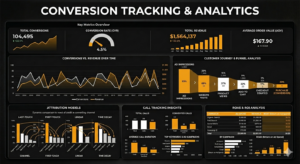
Accurate conversion tracking enables better optimization and budget allocation decisions.
A paid search strategy cannot succeed over the long term without a rigorous, technically precise conversion tracking framework. Conversion tracking is the foundational data infrastructure that transforms anonymous clicks into clear, actionable business intelligence. Without accurate tracking, machine learning models and automated bidding algorithms cannot properly optimize their targeting parameters. Setting up this framework requires deploying global site tags, configuring explicit event triggers, and establishing cross-domain tracking patterns to monitor the entire customer journey.
Modern analytics tracking must capture multiple layers of user interaction, moving far beyond basic form submissions to include deep button clicks, video engagements, and phone calls. Integrating offline conversion data into your tracking loop allows you to attribute pipeline revenue directly to the specific keywords and ad campaigns that generated the initial lead. This deep visibility enables performance marketing managers to eliminate low-performing ad spend and aggressively shift budget into high-yield search categories. Ultimately, maintaining clean data pipelines protects your marketing investment and establishes a reliable baseline for continuous performance testing.
Scaling a Google Ads account requires a data-driven approach to budget allocation that balances predictable performance with controlled testing. Many advertisers make the mistake of increasing budgets too quickly, which can destabilize ad auctions, dilute Quality Scores, and cause costs-per-acquisition to spike. A structured scaling strategy involves incrementally increasing budgets by 15% to 20% on campaigns that consistently hit performance targets. This incremental approach gives the platform’s bidding algorithms enough time to adjust to the higher spend without resetting the critical learning phase.
Simultaneously, scaling your account’s reach requires expanding horizontally into new keyword territories, adjacent target audiences, and broader match types. Marketers can reinvest profits from mature, high-performing search terms into exploratory campaigns designed to uncover untapped market segments. This approach creates a two-tiered system where core revenue drivers run alongside controlled, lower-risk growth experiments. By systematically reallocating capital based on historical performance, businesses can expand their search footprint, defend their market share against competitors, and drive continuous growth.
While keyword targeting captures active search intent, layering advanced audience segments allows you to refine your focus and improve conversion efficiency. Audience targeting in Google Ads lets you tailor bid strategies and ad creatives to specific user demographics, life events, and detailed in-market behaviors. By combining high-intent search queries with relevant audience filters, you ensure your ads serve primarily to your highest-value prospects. This multi-layered approach prevents ad waste on low-converting demographics and focuses your budget where it delivers the most impact.
Remarketing Lists for Search Ads (RLSA) are highly effective for re-engaging users who previously visited your website but left without converting. Because these users are already familiar with your brand, you can bid more aggressively on high-competition keywords when they search for them again. Additionally, crafting tailored ad copy that speaks directly to their previous browsing behavior can nudges them back into your conversion funnel. Integrating lookalike or similar audiences helps you find new potential customers who share behaviors with your existing buyers, expanding your reach while keeping acquisition costs predictable.
Sustaining a competitive advantage in paid search requires ongoing, data-driven analysis of your competitors’ strategies, budget shifts, and ad copy variations. Auction Insights reports within the Google Ads dashboard provide valuable visibility into which competitors are bidding on the same keyword clusters. These reports show key performance metrics like impression share, overlap rate, and position-above rate, helping you see exactly where rivals are winning. Tracking these shifts lets you adjust your bidding tactics ahead of time to protect your core market positions.
External competitive intelligence tools provide deeper insights into your competitors’ landing page layouts, creative copy strategies, and historical spending patterns. Analyzing these external data points helps you spot gaps in their messaging, revealing opportunities to highlight your own unique value propositions. If a competitor focuses entirely on a low price point, you can adjust your ad copy to emphasize superior quality or comprehensive customer support. This strategic positioning ensures your ads stand out on the results page, capturing highly qualified clicks and taking market share from less agile competitors.
Continuous creative testing is essential for improving click-through rates, elevating Quality Scores, and lowering your average cost-per-click metrics over time. A/B split testing should be treated as a rigorous, scientific process where you isolate and evaluate specific variables to understand performance shifts. When testing responsive search ads, this means systematically changing headlines, promotional offers, and calls-to-action rather than rewriting entire ads at once. This disciplined approach ensures that any change in performance can be clearly attributed to a specific modification.
To ensure your testing yields actionable insights, you must let experiments run until they achieve statistical significance before making major strategy shifts. Making account adjustments based on limited data can cause you to optimize for temporary traffic anomalies rather than long-term consumer trends. Once a test reveals a clear winner, that high-performing creative becomes your new baseline, and you can introduce a new variation to challenge it. Maintaining this continuous optimization cycle keeps your messaging fresh, fights ad fatigue, and drives steady performance improvements across your entire account.
Building a sustainable digital marketing engine requires strict adherence to Google’s evolving ad policies, editorial guidelines, and technical compliance frameworks. The platform enforces strict rules regarding trademark usage, copyright protections, landing page functionality, and the promotion of regulated industries like finance or healthcare. Violating these policies can lead to immediate ad rejections, lower Quality Scores, or complete account suspensions that halt customer acquisition. Advertisers must proactively audit their assets to ensure all ad copy and landing pages stay fully compliant with current platform standards.
Beyond creative and policy compliance, securing your account’s data infrastructure is essential for protecting your corporate assets and customer privacy. Implementing mandatory two-factor authentication, enforcing strict user access controls, and running routine security audits prevents unauthorized access and malicious campaign changes. At the same time, aligning your data collection practices with global privacy laws—like GDPR and CCPA—ensures your tracking remain compliant. Maintaining a secure, policy-compliant account ecosystem protects your brand’s digital presence and ensures your paid search infrastructure runs smoothly without unexpected disruptions.
Mastering the complexities of paid search and executing campaigns that rank for thousands of keywords requires advanced, structured training. While self-directed study can teach you basic terminology, it rarely gives you the deep tactical expertise needed to confidently manage large marketing budgets. True mastery comes from hands-on practice, analyzing real-world campaign data, and learning directly from industry experts who manage high-performance accounts daily. This comprehensive level of education bridges the gap between basic platform knowledge and advanced marketing execution.
For professionals and business owners looking to build this elite skillset, the digital marketing course at Asmat Institute offers a comprehensive learning path. Located in Delhi’s, Asmat Institute provides an immersive, practical curriculum that covers everything from foundational auction mechanics to advanced automated bidding strategies. Students gain valuable experience by working on live campaigns, learning to build scalable account structures, optimize conversion tracking, and analyze competitor data. By studying at Asmat Institute, you can fast-track your professional growth, earn recognized certifications, and build the confidence needed to scale any digital business.