
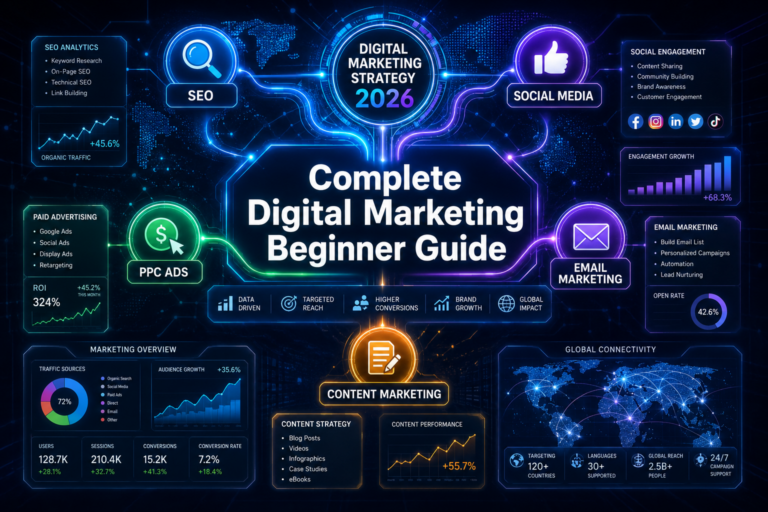
Complete Digital Marketing Beginner Guide Overview
Digital marketing is the practice of promoting products and services using online platforms such as search engines, social media, websites, email, and paid advertising. It is one of the fastest-growing industries because consumers now rely heavily on digital platforms to make purchasing decisions.
A Complete Digital Marketing Beginner Guide helps learners understand how businesses attract, engage, and convert customers online. Instead of traditional marketing methods like newspapers and TV ads, digital marketing focuses on measurable, data-driven strategies.
Today, every industry—from eCommerce to manufacturing—depends on digital presence. Even companies searching for complex solutions like software tools or enterprise systems use online research before making decisions.
Key foundations of digital marketing:
Point-based overview:
Digital marketing is not just a skill—it is a complete ecosystem that connects businesses with customers at every stage of the buying journey.
Digital marketing is all marketing activities that use an electronic device or the internet to promote products and services. This includes strategies to attract, engage and convert potential customers online.
Companies can observe the behavior of users in real time and this makes digital marketing different from traditional marketing. Every click, impression and conversion can be measured and analyzed.
Core areas include:
Even industries that seem offline use digital marketing today. Businesses researching enterprise tools or systems often rely on online content before making decisions.
Point-based breakdown:
Digital marketing also plays a key role in educating users. Many beginners search for guides, tutorials, and definitions before learning advanced strategies.
This makes it one of the most powerful tools for both businesses and individuals entering the online world.
For beginners, digital marketing offers a strong foundation for career growth, freelancing, and business development. It is one of the most in-demand skills globally because every company needs an online presence.
Learning a Complete Digital Marketing Beginner Guide helps individuals understand how online systems work and how businesses generate revenue digitally.
Why it matters:
Point-based importance:
Beginners can start with simple areas like SEO, content writing, or social media management and gradually move into advanced topics like analytics and automation.
Digital marketing also helps understand customer psychology, behavior tracking, and conversion strategies.
Even industries like manufacturing now rely on digital systems for lead generation and brand awareness.
This makes digital marketing not just a skill, but a long-term career path with unlimited growth potential.
Digital marketing consists of multiple channels that work together to create a complete online strategy. Each channel has a specific role in attracting and converting customers.
Main channels include:
Improves organic ranking on Google.
Engages users on platforms like Facebook, Instagram, and LinkedIn.
Focuses on blogs, videos, and articles.
Paid ads that generate instant traffic.
Used for nurturing leads and customer retention.
Point-based structure:
A strong digital marketing strategy uses all channels together instead of relying on one.
Beginners should understand how each channel fits into the customer journey—from awareness to conversion.
This integrated approach ensures better results and higher ROI.
SEO (Search Engine Optimization) is the process of improving website visibility on search engines like Google. It is one of the most important parts of digital marketing.
SEO helps websites rank for keywords, attract organic traffic, and generate leads without paid ads.
Key SEO elements:
Point-based SEO basics:
SEO is especially important for ranking educational and commercial content. For example, beginners searching for guides or tools rely heavily on search engines.
A strong SEO strategy includes:
SEO is a long-term strategy that builds sustainable traffic and brand authority over time.
Content marketing focuses on creating valuable, relevant, and consistent content to attract and retain an audience.
It is one of the most powerful tools in digital marketing because it builds trust and authority.
Types of content:
Point-based benefits:
Content marketing works at every stage of the buyer journey. Users first discover content, then engage with it, and finally convert into customers.
For beginners, content marketing is the easiest entry point into digital marketing because it does not require heavy technical skills.
High-quality content also supports SEO by targeting multiple keywords and improving visibility.
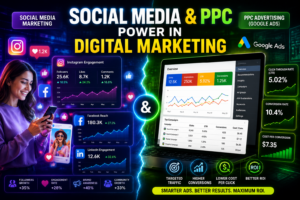
Social media and PPC advertising dashboards showing growth and engagement
Social media marketing involves using platforms like Facebook, Instagram, LinkedIn, and YouTube to promote products and engage audiences.
It is one of the fastest ways to build brand awareness and connect with users directly.
Key activities:
Point-based advantages:
Social media is essential for both B2C and B2B industries. Even professional services use platforms like LinkedIn to generate leads.
Beginners should focus on consistency, content quality, and audience engagement.
Social media also supports SEO indirectly by driving traffic and increasing visibility.
PPC is a paid advertising model where businesses pay for each click on their ads. It provides immediate visibility and traffic.
Google Ads is the most common PPC platform.
Point-based PPC benefits:
PPC is useful for businesses that want quick leads and conversions.
It works well when combined with SEO and content marketing.
Beginners can start with small budgets and scale campaigns based on performance.
Email marketing is the process of sending targeted messages to users via email to promote products or build relationships.
It is one of the highest ROI digital marketing channels.
Point-based advantages:
Email marketing is commonly used for:
It works best when combined with other digital marketing strategies.
A digital marketing strategy is a structured plan to achieve business goals using online channels.
Steps include:
Point-based strategy tips:
A strong strategy ensures consistent growth and better ROI.
Digital marketing uses various tools for SEO, analytics, content creation, and automation.
Popular tools:
Point-based uses:
Tools help marketers save time and improve accuracy. Google Analytics is widely used for tracking performance.
Digital marketing is an essential skill for businesses and individuals in today’s online world. It provides opportunities for growth, visibility, and revenue generation.
A Complete Digital Marketing Beginner Guide helps learners understand SEO, social media, content marketing, PPC, and email marketing.
Point-based summary:
By mastering these fundamentals, beginners can build strong careers or grow businesses effectively.
Digital marketing continues to evolve, making it a long-term and high-value skill for the future.