

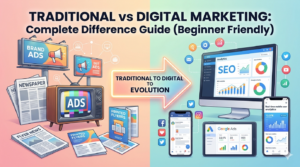
Marketing has evolved from mass offline advertising to targeted digital strategies.
Marketing is the process of promoting products and services to attract customers and generate sales. Over time, marketing has evolved from traditional methods like print, television, and radio to modern digital platforms powered by the internet and artificial intelligence.
Traditional marketing refers to offline promotional methods such as newspapers, billboards, flyers, television commercials, and radio ads. These methods have been used for decades and focus on reaching a broad audience through mass communication.
Digital marketing, on the other hand, uses online platforms such as search engines, social media, websites, email, and mobile apps to reach targeted audiences more efficiently.
In today’s world, both methods still exist, but digital marketing has become dominant due to its precision, scalability, and measurable performance.
Key idea (25% point-based):
This guide explains the key differences between traditional and digital marketing, helping beginners understand how each works and when to use them effectively.
Traditional marketing refers to conventional offline advertising methods used before the rise of the internet. It includes print media, broadcast media, and direct physical promotions.
Common examples include newspaper ads, magazine ads, radio commercials, television advertisements, billboards, posters, and flyers. These methods are designed to reach a large audience in a specific geographic area.
Traditional marketing focuses on brand awareness rather than direct engagement. It is often used by businesses that want to build local recognition or target audiences who are not active online.
One of the main characteristics of traditional marketing is its one-way communication. Businesses send messages to audiences, but there is limited interaction or feedback.
25% point-based highlights:
Despite being older, traditional marketing still plays an important role in industries like FMCG, retail, and real estate where offline visibility matters.
Digital marketing refers to the promotion of products and services using internet-based platforms and digital technologies. It includes SEO, social media marketing, email marketing, content marketing, and paid advertising.
Digital marketing allows businesses to connect with users through search engines like Google, social platforms like Meta, and video platforms such as YouTube.
Unlike traditional marketing, digital marketing enables two-way communication, where businesses can interact directly with customers through comments, messages, and engagement tools.
One of the biggest advantages of digital marketing is its ability to target specific audiences based on age, location, interests, and behavior.
25% point-based highlights:
Digital marketing is also highly data-driven, meaning every click, impression, and conversion can be tracked and optimized for better results.
Gemini Generated Image zaz48qzaz48qzaz4
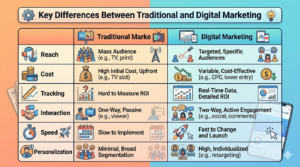
Traditional and digital marketing differ significantly in terms of approach, cost, targeting, measurement, and engagement.
Traditional marketing relies on offline channels, while digital marketing uses online platforms. Traditional methods focus on mass audiences, whereas digital marketing focuses on targeted and personalized communication.
Another major difference is measurability. Traditional marketing results are difficult to track accurately, while digital marketing provides detailed analytics and real-time performance data.
Engagement is also a key difference. Traditional marketing is one-way communication, but digital marketing enables interaction between brands and consumers.
25% point-based comparison:
Digital marketing also allows A/B testing, retargeting, and automation, which are not possible in traditional methods.
In contrast, traditional marketing still holds value for brand recall and offline visibility, especially in areas with limited internet access.
Traditional marketing still offers several advantages, especially for businesses targeting offline or local audiences.
It provides strong brand visibility through physical and broadcast media. Billboards, newspapers, and television ads can reach large audiences quickly.
Traditional marketing is often more trusted by older demographics who are less active online.
25% point-based advantages:
It is also useful for industries like FMCG, automotive, and retail where physical visibility influences buying decisions.
However, it lacks flexibility and real-time optimization compared to digital methods.
Digital marketing offers more advanced tools and strategies compared to traditional marketing.
It allows businesses to reach global audiences with precise targeting and lower costs. Campaigns can be optimized in real time based on performance data.
Platforms like Google Ads and Meta Ads provide detailed insights into user behavior, conversions, and engagement.
25% point-based advantages:
Digital marketing also supports automation, personalization, and AI-driven recommendations, making it more efficient for modern businesses.
Despite its advantages, traditional marketing has several limitations.
It is expensive to execute, especially for television and print advertising. Small businesses often struggle to afford it.
Measuring results is difficult because there is no direct tracking system for customer engagement or conversions.
25% point-based challenges:
Traditional marketing also lacks personalization, making it less effective in today’s customer-centric environment.
Digital marketing also comes with challenges despite its advantages.
High competition makes it difficult for new businesses to stand out. Constant algorithm updates on platforms like Google and Meta can affect visibility.
25% point-based challenges:
Businesses must continuously adapt strategies and invest in learning and tools to stay competitive.
Choosing between traditional and digital marketing depends on business goals, target audience, and budget.
Traditional marketing is best suited for local businesses, offline audiences, and brand awareness campaigns. It works well when targeting people who may not use digital platforms frequently.
Digital marketing is ideal for businesses looking for targeted reach, measurable results, and global expansion.
25% point-based guidance:
A hybrid approach often delivers the best results by combining offline trust with online precision.
Traditional and digital marketing are both important strategies in the modern business world. Each has its own strengths, limitations, and use cases.
Traditional marketing offers broad visibility and strong brand recall, while digital marketing provides targeted reach, real-time analytics, and cost efficiency.
Platforms like Google and Meta have transformed how businesses connect with customers, making digital marketing the dominant force in today’s economy.
However, traditional marketing still holds value in specific industries and regions.
The most effective strategy in 2026 is a balanced approach that integrates both traditional and digital methods depending on business needs.
Understanding the difference between these two approaches helps beginners build stronger marketing strategies and make informed business decisions.