
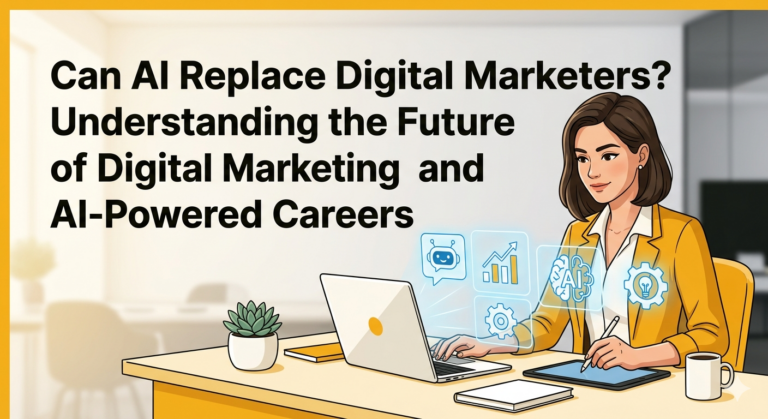
Digital marketing has evolved rapidly over the last decade, and the introduction of Artificial Intelligence (AI) has accelerated this transformation even further. From automated content creation and predictive analytics to AI-powered chatbots and campaign optimization tools, businesses are increasingly relying on intelligent systems to improve marketing performance. As AI becomes more advanced, one question continues to dominate discussions among students, professionals, and business owners: Can AI replace digital marketers?
The concern is understandable. AI tools can generate content, analyze customer behavior, automate advertising campaigns, and even make data-driven recommendations faster than humans. However, the reality is more nuanced than a simple replacement scenario. Rather than eliminating digital marketing jobs, AI is fundamentally changing how marketers work, what skills they need, and how businesses achieve growth in a competitive digital landscape.
For aspiring professionals considering a digital marketing course with AI in Delhi, understanding this relationship between AI and digital marketing is essential. The future belongs not to those who compete against AI but to those who learn how to leverage it effectively.
In this article, we will explore the impact of AI on digital marketing, examine whether automation can truly replace human marketers, and discuss why AI-powered digital marketing skills are becoming some of the most valuable competencies in today’s job market.
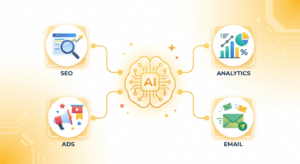
How AI integrates into modern digital marketing systems.
Artificial Intelligence has become a driving force behind many modern marketing strategies. Businesses of all sizes are using AI-powered tools to streamline processes, improve customer experiences, and generate better results from their marketing investments.
The rapid adoption of AI is largely due to its ability to process massive amounts of data, identify patterns, and make predictions in real time. Tasks that once required hours of manual effort can now be completed within minutes using advanced algorithms.
Some of the most common applications of AI in digital marketing include:
Today’s marketers use AI tools to enhance efficiency rather than replace human involvement entirely. Platforms powered by machine learning can identify trends and opportunities that might otherwise go unnoticed, enabling marketers to make smarter strategic decisions.
As digital channels become more competitive, organizations are increasingly seeking professionals who understand both traditional marketing principles and emerging AI technologies. This growing demand is one reason why AI-integrated digital marketing training programs are attracting significant attention among students and working professionals.
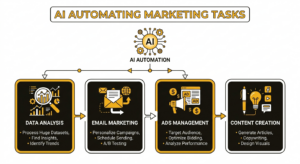
AI improves efficiency by automating repetitive marketing tasks.
One of the reasons people fear job displacement is that AI can outperform humans in certain repetitive and data-intensive activities. Digital marketing contains many operational tasks that are highly suitable for automation.
AI excels when it comes to processing information at scale and identifying patterns that would be difficult for humans to detect manually.
AI can analyze millions of data points in seconds, helping marketers understand:
This allows businesses to make faster and more accurate marketing decisions.
AI-powered systems can automate numerous processes, including:
Automation reduces manual workload while improving consistency.
Modern AI tools can generate:
These capabilities help marketers produce content more efficiently.
AI can forecast future outcomes by analyzing historical data, helping businesses predict:
Such predictive insights allow companies to allocate marketing budgets more effectively.
Consumers increasingly expect personalized experiences. AI makes this possible through:
These capabilities significantly improve customer engagement and conversion rates.
While these functions demonstrate AI’s impressive capabilities, they represent only one side of the digital marketing equation.
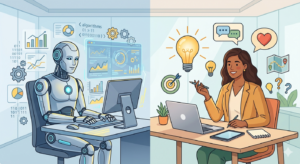
Human creativity and AI automation work together for better marketing results.
Although AI is powerful, digital marketing extends far beyond automation and data analysis. Successful marketing depends heavily on creativity, emotional intelligence, strategic thinking, and human understanding—areas where AI still has significant limitations.
Marketing is fundamentally about connecting with people, understanding their needs, and building meaningful relationships between brands and customers.
AI can provide recommendations, but humans determine:
Strategic thinking requires contextual understanding that goes beyond data patterns.
AI generates content based on existing information. Human marketers create:
Groundbreaking marketing campaigns often emerge from human imagination rather than algorithmic predictions.
Consumers make decisions based on emotions as much as logic. Human marketers understand:
These insights help create authentic marketing messages that resonate with audiences.
Marketing involves collaboration with:
Human communication skills remain essential for building trust and maintaining professional relationships.
AI follows instructions and patterns, but humans must evaluate:
Organizations still require human oversight to ensure responsible marketing decisions.
As a result, AI functions best as a powerful assistant rather than a complete replacement for skilled digital marketers.
Rather than eliminating jobs, AI is reshaping digital marketing roles. The industry is experiencing a shift from manual execution toward strategic management and technology integration.
Modern marketers are increasingly expected to understand both marketing fundamentals and AI-driven tools.
Professionals who want to remain competitive should focus on developing expertise in:
The most successful marketers are becoming technology-enabled strategists who can combine human creativity with machine efficiency.
AI adoption is creating entirely new roles within the marketing industry, including:
These positions often command higher salaries because they require a combination of marketing expertise and technological proficiency.
Companies are increasingly prioritizing candidates who understand how to use AI tools effectively while maintaining strong marketing fundamentals.
Start building future-ready skills in AI-powered digital marketing.
The digital marketing landscape is evolving faster than ever before. Businesses no longer seek professionals who only understand traditional marketing tactics. They want marketers who can leverage artificial intelligence to improve efficiency, drive growth, and generate measurable results.
A modern digital marketing course with AI in Delhi typically combines foundational marketing concepts with practical AI applications. Students learn how to integrate intelligent tools into real-world marketing workflows while maintaining a strategic, customer-focused approach.
Some of the most valuable areas covered in AI-focused digital marketing training include:
Professionals equipped with these skills are often better positioned to adapt to industry changes and capitalize on emerging opportunities.
As AI continues to become a core component of digital marketing operations, understanding how to work alongside these technologies will become increasingly important for career growth and long-term success.
In the second half of this article, we will explore the future of AI and digital marketing, discuss job opportunities, salary prospects, industry demand, the benefits of enrolling in a Digital Marketing Course with AI in Delhi, and answer the most frequently asked questions about AI-powered marketing careers.